Normal view

There are new articles available, click to refresh the page.
Before yesterdayOPEN JOURNAL SYSTEM SERVICES

Why Zenodo DOI for Academic Journals?

March 30th 2026 at 1:29 am

Zenodo is a free, open-access repository developed by CERN that allows researchers and publishers to assign Digital Object Identifiers (DOIs) to their publications — completely free of charge. Unlike commercial DOI providers, Zenodo offers unlimited DOI registration with no annual fees, making it an ideal solution for academic journals operating on limited budgets.

With a Zenodo DOI, your articles gain permanent, citable identifiers that are indexed by major academic databases, ensuring long-term discoverability and accessibility for the global research community.

How Zenodo DOI Works — What to Expect

It’s important to understand how Zenodo DOIs differ from services like CrossRef or DataCite. When you assign a DOI through Zenodo:

  • The DOI link (e.g., https://doi.org/10.5281/zenodo.12345) resolves to the Zenodo record page, not directly to your journal website.
  • Zenodo stores a copy of your article (PDF and metadata) as an open-access archive on its platform.
  • Your journal URL is included in the Zenodo metadata, so readers can easily find and visit your journal from the Zenodo page.

This is different from CrossRef, where the DOI link points directly to the article on your journal website. With Zenodo, your article gains an additional presence on a trusted, CERN-hosted repository — providing extra visibility, long-term preservation, and credibility. Many journals use Zenodo DOIs as a cost-free alternative to commercial DOI services, and the Zenodo landing page serves as a secondary access point that complements your journal.

The Challenge: A Tedious Manual Process

While Zenodo provides an excellent free DOI service, the process of depositing articles is entirely manual. For each article, journal editors must:

  1. Log in to Zenodo and create a new upload to reserve a DOI
  2. Copy the DOI and add it to the article’s PDF and OJS metadata
  3. After publishing the article in OJS, return to Zenodo
  4. Manually enter all metadata — title, authors, affiliations, abstract, keywords
  5. Fill in publishing information — journal name, ISSN, volume, issue, page numbers
  6. Upload the PDF file
  7. Review everything and publish the record

This process takes 10–15 minutes per article and is highly prone to errors — typos in author names, missing affiliations, incorrect page numbers, or forgotten keywords. For journals publishing 30–100+ articles per year, this becomes a significant burden on editorial staff.

Our Solution: Zenodo DOI Sync Plugin for OJS

Based on direct feedback and requests from our OJS clients and the academic publishing community, we developed the Zenodo DOI Sync Plugin — a comprehensive integration that automates the entire Zenodo deposit workflow directly from within OJS.

What previously took 10–15 minutes of manual data entry per article now takes a single click and a few seconds. All metadata is pulled directly from OJS, eliminating human error and ensuring consistency between your journal and Zenodo records.

We continue to actively develop this plugin and provide dedicated support based on user feedback and evolving Zenodo API requirements.

Key Features

🔑 Secure Token-Based Authentication

The plugin connects to Zenodo using your personal access token — no passwords stored, no complex OAuth flows. Simply generate a token from your Zenodo account and paste it into the plugin settings. Each journal can have its own Zenodo account and token.

🏷️ One-Click DOI Reservation

Reserve a DOI from Zenodo without leaving OJS. The DOI is automatically saved to the article’s identifier field. No need to switch between OJS and Zenodo.

📋 Automatic Metadata Synchronization

With a single click, the plugin transfers all article metadata to Zenodo:

  • Title — in the article’s original language
  • Authors — with full names, affiliations, and ORCID identifiers
  • Abstract — with HTML formatting preserved (bold, italic, paragraphs)
  • Keywords — all subject keywords from the article
  • Journal Information — journal name, ISSN, volume, issue, page numbers
  • Publication Date — from the OJS publishing date

📄 Automatic File Upload

The plugin automatically uploads all galley files (PDF and others) from OJS to Zenodo. It handles file cleanup — removing old files before uploading new ones — ensuring your Zenodo record always matches your OJS content.

🌐 Zenodo Community Integration

If your journal has a Zenodo community, the plugin can automatically associate new deposits with your community. Simply enter your community slug in the settings, and every new DOI reservation will be linked to your community page.

🚀 Publish to Zenodo from OJS

Once your article is published in OJS, you can publish it to Zenodo with one click. The plugin handles metadata sync, file upload, community review submission, and publication — all in a single operation.

📊 DOI Management Dashboard

A dedicated management page in the OJS sidebar gives you a complete overview of all articles and their Zenodo status:

  • Filter by Zenodo status (Draft / Published), OJS status, or issue
  • Search by title, DOI, or article ID
  • Sort by any column
  • Sync or publish individual articles directly from the dashboard
  • Color-coded status badges for instant visual overview

🔄 Legacy DOI Scanner

Already have articles with Zenodo DOIs that were created manually? The built-in scanner finds all existing Zenodo DOIs in your journal, checks their current status on Zenodo (draft or published), and updates the local database — so you can manage everything from one place.

🌍 Multi-Language Support

The plugin interface is fully translated in English and Turkish, with support for additional languages. All labels, messages, and notifications adapt to your OJS language setting.

🔒 Role-Based Access Control

Only Site Administrators and Journal Managers can access Zenodo features. Authors, reviewers, and other users cannot see or interact with DOI management tools.

What’s Included

  • ✅ Full plugin with all features described above
  • ✅ Installation and configuration support
  • ✅ Zenodo account and token setup assistance
  • ✅ Community configuration help
  • ✅ Free updates for compatibility and improvements
  • ✅ Ongoing technical support

Continuous Updates & Important Notes

This plugin is actively maintained and regularly updated to keep pace with OJS releases and Zenodo API changes. All updates are provided free of charge.

A note about Zenodo: Zenodo is an independent service operated by CERN with its own policies and eligibility criteria. While Zenodo offers free DOI registration for most academic content, they may apply restrictions on certain types of publications or journals at their discretion. Such policies are determined solely by Zenodo and are outside the scope of this plugin. We recommend checking Zenodo’s policies to confirm eligibility for your journal.

Compatibility

  • OJS Version: 3.3.x
  • PHP: 7.4, 8.0, 8.1
  • Zenodo API: InvenioRDM REST API

Get the Plugin →

The post Why Zenodo DOI for Academic Journals? first appeared on OPEN JOURNAL SYSTEM SERVICES.

RepecPro – RePEc Export Plugin for OJS 3.3 & 3.4

March 25th 2026 at 7:18 pm

If your journal publishes research in economics, finance, business, or related social sciences, getting indexed in RePEc (Research Papers in Economics) is one of the most effective ways to boost your visibility — and it’s completely free.

RePEc is a decentralized, volunteer-driven platform that distributes your research metadata across a vast network of services including IDEAS, EconPapers, CitEc, Google Scholar, EconLit, ResearchGate, and many more. With over 4,200 journals and 70,000 registered authors across 104 countries, it’s one of the largest open bibliographic databases in the social sciences.

But here’s the catch: joining RePEc requires creating structured metadata files in ReDIF format, maintaining a specific directory structure, and keeping everything updated as you publish new issues. For most journal teams, this is tedious, technical, and error-prone.

That’s exactly why we built RepecPro.

What Is RepecPro?

RepecPro is a professional export plugin for Open Journal Systems (OJS) that fully automates your journal’s RePEc integration. No need to learn ReDIF syntax, no manual file management, no worrying about directory structures. Install the plugin, enter your RePEc archive details, and export — it’s that simple.

RepecPro supports both OJS 3.3.x and OJS 3.4.x.

Key Features

Automated ReDIF Template Generation

RepecPro automatically generates all required ReDIF files — archive template, series template, and individual article templates — directly from your OJS article metadata. Titles, authors, abstracts, keywords, publication dates, DOIs, PDF links — everything is mapped correctly.

Full Export & Selective Export

Export your entire journal catalog with a single click using Full Export, or selectively export specific issues or individual articles. Perfect for both initial setup and ongoing updates.

Auto-Export on Publication

Enable automatic export and RepecPro will generate ReDIF files whenever a new article is published. No manual intervention needed — your RePEc archive stays up to date automatically.

Directory Structure & Index Files

RepecPro creates and manages the complete directory structure that RePEc’s crawler requires, including HTML index files at every level. Your archive is HTTP-accessible and ready for RePEc’s mirroring software from day one.

Configuration Validator

Before exporting, run the built-in Validate Configuration tool to check that all required settings are properly configured. Catch issues before they become problems.

Export History & Logging

Every export operation — whether manual or automatic — is logged with detailed information: date, type, status, article count, and any errors. The Recent Exports tab gives you a complete audit trail.

Multi-Language Support

Full interface support in English and Turkish, with contextual help text for every settings field.

Smart Defaults

RepecPro pre-fills settings with sensible defaults based on your journal’s existing OJS configuration — journal name, ISSN, publisher, and more. Just review and adjust as needed.

How It Works

  1. Install — Upload the plugin via OJS Plugin Gallery or manually
  2. Configure — Go to Tools → Import/Export → RepecPro and enter your RePEc archive code, series code, and base URL
  3. Export — Click Full Export to generate all ReDIF files
  4. Verify — Test HTTP access to your archive URL and validate with RePEc
  5. Register — Send your archive URL to the RePEc team for inclusion

That’s it. Your journal is on RePEc.

What Gets Exported?

For each published article, RepecPro generates a complete ReDIF record including:

  • Article title and abstract
  • All author names and affiliations
  • Publication date, volume, issue, and pages
  • Keywords / JEL classification codes
  • DOI (if available)
  • Direct PDF download URL
  • Article landing page URL

Compatibility

Feature OJS 3.3 OJS 3.4
Automatic ReDIF generation
Full / Selective export
Auto-export on publish
Configuration validator
Export history & logging
English / Turkish UI

Get RepecPro

Ready to get your journal indexed on RePEc — the easy way?

Get RepecPro Export Plugin →

REPEC PRO GUIDE

Need help with installation or RePEc registration? Contact us — we’re here to help.


RepecPro is developed and maintained by OJS Services, providing professional OJS solutions for academic publishers worldwide.

The post RepecPro – RePEc Export Plugin for OJS 3.3 & 3.4 first appeared on OPEN JOURNAL SYSTEM SERVICES.

Country Statistics for OJS (Authors and Articles by Country)

March 4th 2026 at 12:43 am

Introducing Country Statistics: Track the Geographic Reach of Your OJS Journal

Prove your journal’s international diversity to indexing bodies — with one plugin.


When applying to Web of Science, Scopus, DOAJ, or other prestigious indexes, there is one question that almost every journal faces:
How geographically diverse is your author base? Indexing committees look for evidence that a journal attracts contributors from a wide range of countries.
It signals international relevance, editorial quality, and scholarly impact beyond regional boundaries.

Until now, answering that question in OJS meant manually combing through submission records, building spreadsheets, and hoping you did not miss anyone.
We built Country Statistics to eliminate that entire process.

What Does Country Statistics Do?

Country Statistics is a free, open-source analytics plugin for OJS 3.3 that automatically analyzes your published submissions and shows you exactly where your authors come from —
visualized through interactive charts, detailed tables, and exportable data.

Once installed, a new Country Statistics menu item appears in the OJS management sidebar. Click it, and you are greeted with a full analytics dashboard:

Admin Dashboard — summary cards, bar chart, donut chart, and data tables

The dashboard provides four key metrics at a glance:

  • Published Articles — total number of published articles in the journal
  • Unique Authors — deduplicated author count across all publications
  • Countries — number of distinct countries represented
  • Top Country Share — the percentage held by the leading contributor country

Below the summary cards, a horizontal bar chart displays the top 12 contributing countries, while a donut chart breaks down the proportional author distribution.
Both update in real time as you change filters.

Smart Author Deduplication

A common challenge in author-country analysis is counting: if the same researcher has published five articles, should they count as five authors or one?
Country Statistics handles this with a configurable deduplication engine.

You choose the identification strategy:

  • ORCID — the gold standard for unique researcher identification
  • Email — useful when ORCID data is sparse
  • Full Name — a simple fallback for legacy data

When ORCID is selected, you can also define a fallback chain for authors who lack an ORCID — for example, try email first, then full name.
This ensures the most accurate count possible regardless of your journal’s metadata completeness.

Plugin Settings — deduplication strategy, display format, public page options

Two Tabs, Two Perspectives

The data tables are organized under two tabs:

Authors by Country — shows how many unique authors come from each country, with percentage share and a visual distribution bar. This is the metric most indexing bodies care about.

Articles by Country — shows how many published articles are associated with each country (an article with authors from three countries counts once for each). This gives you the publication volume perspective.

Both tables are fully searchable. Type a country name, and the table filters instantly. Need the data outside OJS?
Hit the CSV button to export everything — UTF-8 encoded and ready for your spreadsheet or index application form.

A Public Page for Transparency

Beyond the admin dashboard, Country Statistics offers an optional public-facing statistics page.
When enabled, this page displays the same charts and tables (without admin controls) to anyone visiting your journal’s website.

Public Page — charts and tables visible to site visitors

Why make this data public? Because transparency builds trust. Prospective authors can see that your journal has genuine international reach.
Indexing committees can verify your claims directly. Readers can appreciate the diversity behind the research they are consuming.

The public page title is fully customizable — call it “International Reach,” “Global Contributors,” “Geographic Distribution,” or whatever suits your journal’s tone.
You can add it to any navigation menu through OJS’s built-in Navigation Menu system with a dedicated menu item type.

Flexible Filtering for Admins

The admin dashboard goes further with real-time filters:

  • Time Range — view all-time data, or limit to the last 12 or 24 months
  • Unique Strategy — switch between ORCID, email, or name-based counting on the fly to compare results
  • Minimum Threshold — hide countries with fewer than N authors or articles to reduce noise

These filters let you generate exactly the dataset you need for different reports or application forms.

Why We Built It This Way

We deliberately designed Country Statistics with zero external dependencies. There are no CDN-hosted chart libraries, no API calls to third-party services, no npm packages to maintain.
Every chart is rendered using pure SVG. Every interaction runs on vanilla JavaScript.

This means:

  • Fast load times — nothing to fetch from external servers
  • No privacy concerns — no data leaves your server
  • No maintenance burden — no library updates to track or security patches to worry about
  • Broad compatibility — works in any modern browser without polyfills

The plugin also ships with English and Turkish translations, and adding more languages is straightforward through standard .po locale files.

Installation in Under a Minute

  1. Download the latest .tar.gz from the GitHub releases page
  2. In OJS, go to Settings → Website → Plugins → Upload A New Plugin
  3. Upload the file and enable it under Generic Plugins

That is it. No database migrations, no configuration files to edit, no server dependencies to install.
The plugin reads your existing submission metadata and starts working immediately.

If you use our Bulk Plugin Manager, Country Statistics is automatically detected and can be installed
or updated directly from the plugin management interface.

Who Is This For?

  • Journal Managers preparing index applications (Web of Science, Scopus, DOAJ) who need geographic diversity data
  • Editors-in-Chief evaluating their journal’s international reach and identifying underrepresented regions
  • Editorial Boards building strategic outreach plans based on contributor geography
  • University Press Teams reporting publishing metrics to institutional stakeholders

If your journal publishes research and you care about where your authors come from, this plugin gives you the answer in seconds.

Open Source and Free

Country Statistics is released under the GNU General Public License v3.0. It is completely free to use, modify, and distribute.
The source code is available on GitHub.


Have questions, found a bug, or want to request a feature? Open an issue on
GitHub
or reach out at info@ojs-services.com.

We build tools that make OJS better for everyone. Stay tuned for more.

— OJS Services Team

The post Country Statistics for OJS (Authors and Articles by Country) first appeared on OPEN JOURNAL SYSTEM SERVICES.

Review Certificate Pro: Professional Reviewer Certificates for OJS 3.3

February 16th 2026 at 11:42 pm

Generate professional, verifiable PDF certificates for peer reviewers directly from your OJS dashboard. Multilingual support, QR verification, bulk operations, and more.

Every Reviewer Deserves Recognition

Peer review is the backbone of academic publishing. Reviewers dedicate hours of their expertise — yet most journals offer little more than a thank-you email in return.

What if you could hand every reviewer a professionally designed, verifiable certificate — without leaving your OJS dashboard?

That’s exactly what Review Certificate Pro does. See Certificate Templates


What Is Review Certificate Pro?

Review Certificate Pro is a premium plugin for Open Journal Systems (OJS) 3.3 that automates the entire reviewer certification workflow. Generate multilingual PDF certificates, verify them with QR codes, track downloads, send notification emails — all from a centralized management interface integrated directly into your OJS backend.

No external tools. No manual PDF editing. No spreadsheets.

Screenshot of the management dashboard showing the certificate list with filters, bulk toolbar, and action buttons


Key Features at a Glance

Professionally Designed PDF Certificates

Each certificate is generated as a high-quality A4 landscape PDF with:

  • Triple border frame with gold corner ornaments
  • Journal logo and ISSN/e-ISSN
  • Reviewer’s full name and article title
  • Editor-in-Chief and Managing Editor signatures
  • Unique verification code
  • QR code for instant verification

Sample certificate PDF showing the full design with borders, signatures, QR code, and verification code


Multilingual — Not Just English

The plugin generates a separate PDF for each active language in your journal. If your OJS runs Turkish and English, every reviewer gets both versions with a single click.

Want to add Russian, Arabic, Spanish, or any other language? Just create a locale folder — the plugin detects it automatically.

QR Code Verification

Every certificate carries a unique verification code and a scannable QR code. Anyone — reviewers, institutions, funding agencies — can verify a certificate’s authenticity instantly.

The public verification page supports two flows:

  • QR scan / direct link: Instant results, no challenge required
  • Manual code entry: Protected by a math-based anti-bot challenge

Verification page showing a successful verification result with certificate details


Centralized Management Dashboard

Forget navigating submission by submission. The management dashboard lists every review assignment across your entire journal in one place.

  • Filter by issue, by status, or search by reviewer name
  • See at a glance: who has a certificate, who has been notified, who has downloaded
  • Direct links to each submission’s workflow page
  • Pagination for journals with thousands of reviews


Bulk Operations

Select multiple reviewers and:

  • Bulk Generate: Create certificates for all selected eligible reviews
  • Bulk Notify: Send notification emails to all selected reviewers who haven’t been notified yet

A progress indicator keeps you informed: (3/12)...

Perfect for journals that want to issue certificates retroactively for past volumes.

Email Notifications with Preview

Customize the notification email template with placeholders like {reviewerName}{articleTitle}{journalName}, and {verificationCode}.

Before sending, click the preview button to see exactly what the reviewer will receive. If it looks right, send it directly from the preview modal.

Email preview modal showing the populated email with To, Subject, and Body fields

Download Tracking

Know whether a reviewer has actually downloaded their certificate. Download counts are displayed in both the workflow tab and the management dashboard — so you can follow up with reviewers who haven’t collected theirs.

Reviewer Self-Service

Reviewers don’t need to contact the editorial office. Once a certificate is generated, download buttons appear automatically on:

  • The reviewer’s completed review page
  • The reviewer’s submissions list

They can download their certificate in any available language, at any time.

Retroactive Support

Already published 50 issues before installing the plugin? No problem. Review Certificate Pro reads from the existing OJS review_assignments table. Any completed review for a published article is eligible — regardless of when it was completed.


How It Works

  1. Install the plugin via OJS Settings > Website > Plugins
  2. Configure your Editor-in-Chief name, optional Managing Editor, and email template
  3. Generate certificates from the workflow tab or the management dashboard
  4. Preview and send notification emails to reviewers
  5. Reviewers download their certificates from their OJS account

That’s it. Five steps from installation to happy reviewers.


Built for Security

  • CSRF protection on all actions
  • Role-based authorization (Site Admin, Journal Manager, Sub-Editor)
  • Parameterized database queries — no SQL injection
  • HMAC-signed verification tokens with expiry
  • PDF files stored outside the web root
  • Certificate context isolation per journal

What’s Included with Your Purchase

Lifetime license Single OJS installation, no recurring fees
All future updates New features and compatibility updates included
Installation support We help you install and configure the plugin
Priority email support Technical issues resolved promptly
Customization guidance Advice on adapting the plugin to your journal’s needs

Requirements

  • OJS 3.3.0.x
  • PHP 7.4 or 8.1+
  • TCPDF library (included with the plugin — no extra setup)

Get Review Certificate Pro

Ready to give your reviewers the recognition they deserve?

$99 — Lifetime License

One payment. Lifetime updates. Full support.


Looking for more OJS plugins? Check out our full plugin catalog.

The post Review Certificate Pro: Professional Reviewer Certificates for OJS 3.3 first appeared on OPEN JOURNAL SYSTEM SERVICES.

Why Your Journal Should Be on RePEc (And How to Get There)

February 15th 2026 at 12:07 pm

If you’re running an academic journal in economics, finance, business, or any related social science field, there’s one platform you simply can’t afford to ignore: RePEc — Research Papers in Economics.

But here’s the thing most editors and publishers don’t realize: RePEc isn’t just another database. It’s a massive, volunteer-driven ecosystem that can dramatically boost your journal’s visibility, your authors’ profiles, and your publication’s credibility. And the best part? It’s completely free.

Let’s break down what RePEc is, why it matters for your journal, and how you can get started — especially if you’re running your journal on Open Journal Systems (OJS).

So, What Exactly Is RePEc?

RePEc is a decentralized, open initiative that enhances the dissemination of research in economics and related disciplines. Founded in 1997, it has grown into one of the largest open bibliographic databases in the social sciences.

The numbers speak for themselves: over 2,350 archives from 104 countries have contributed roughly 5 million research items from more than 4,200 journals and 5,600 working paper series. Over 70,000 authors have registered, and 75,000 email subscriptions are served every week.

Unlike traditional indexing services, RePEc works on a beautifully simple model. Publishers place structured metadata files on their own servers, following a standardized format called ReDIF (Research Documents Information Format). RePEc’s system then mirrors and distributes this data across its network of services.

Why Should You Care as a Journal Editor or Publisher?

Here’s where it gets interesting. Being listed on RePEc doesn’t just mean your articles sit in yet another database. It means your content flows into an entire ecosystem of services, each one amplifying your journal’s reach.

Visibility Across Multiple Platforms

When your journal is indexed in RePEc, your articles automatically become discoverable through a wide range of services and platforms. This isn’t just one website — it’s an entire network:

Core RePEc Services:

  • IDEAS — The largest open bibliographic database in economics. Your articles become fully searchable and browsable here, complete with author profiles, citations, and download statistics.
  • EconPapers — Another major gateway to the full RePEc database, offering search and browsing with a different interface and user base.
  • CitEc — Citation analysis for all items in the RePEc database. Your articles get tracked for citations, building a measurable impact trail.
  • NEP (New Economics Papers) — A free email, RSS, and Twitter/X notification service covering over 90 specific fields. When you publish a new working paper, researchers in relevant fields get notified automatically.
  • LogEc — Detailed download and access statistics for your items and authors. You get real data on how your content is being consumed.
  • CollEc — Co-authorship centrality rankings for registered authors.
  • RePEc Biblio — A hand-selected bibliography of important articles and papers in economics.
  • EDIRC — A directory of economics institutions, linking members to their publications on RePEc.
  • RePEc Genealogy — An academic family tree for economics.
  • EconAcademics.org — A blog aggregator for discussion about economics research.
  • RePEc Author Service — Where authors register and maintain their profiles, linking their work across the entire system.
  • MPRA (Munich Personal RePEc Archive) — Authors at institutions without a participating RePEc archive can submit papers here.

Third-Party Platforms Using RePEc Data:

But the reach doesn’t stop at RePEc’s own services. Because RePEc bibliographic data is in the public domain, your content also feeds into:

  • Google Scholar — The go-to search engine for academics worldwide.
  • EconLit — The American Economic Association’s premier database.
  • EconStor — A digital publication server for open-access economics literature.
  • OpenAIRE — The European open science infrastructure.
  • ResearchGate — A massive social networking site for researchers.
  • EBSCO — A leading research database provider.
  • OpenAlex — An open catalog of the world’s scholarly works.
  • OAISter/WORLDCAT — OCLC’s union catalog of digital resources.
  • Microsoft Academic Search and Sciverse — Additional academic search platforms.

That’s a lot of exposure from a single indexing effort.

Author Engagement and Retention

Authors care about where their work is visible. When your journal is on RePEc, your authors can link their publications to their RePEc Author Service profiles, track citations through CitEc, monitor download statistics via LogEc, and receive notifications about new citations. This kind of author engagement is gold for journal editors trying to attract and retain quality submissions.

Rankings and Impact Metrics

RePEc maintains its own ranking system based on various criteria — citations, downloads, and more. Being part of this system gives your journal and its authors measurable, transparent impact metrics that complement traditional measures like Impact Factor.

It’s Free — Seriously

Unlike many indexing services that charge hefty fees, RePEc is entirely volunteer-driven and free for all parties. No submission fees, no listing fees, no annual charges. It’s sustained by a global community of volunteers who believe in open access to research.

Is It Only for Economics?

This is a common misconception. While RePEc started with — and is strongest in — economics, it welcomes related disciplines as well. If your journal publishes research in:

  • Finance and banking
  • Business and management
  • Public policy
  • Agricultural economics
  • Environmental economics
  • Health economics
  • Political economy
  • Econometrics and statistics
  • Development studies
  • International trade
  • Urban and regional economics
  • Law and economics

…then you absolutely belong on RePEc. The key criterion is that your content should be relevant to the economics research community in some way. Many interdisciplinary journals are already on RePEc, and the platform actively encourages related fields to participate.

If you’re unsure whether your journal qualifies, the best approach is to review the existing archives and see if journals similar to yours are already listed — chances are, they are.

How to Get Your Journal on RePEc

The process of joining RePEc involves creating a “RePEc archive” on your server. Here’s the general workflow:

  1. Register as a provider — You’ll need to set up an archive with a unique identifier.
  2. Create metadata files — These are structured text files (using ReDIF syntax) that describe your journal, its issues, and individual articles.
  3. Host them on your server — The files need to be accessible via HTTP, HTTPS, or FTP.
  4. RePEc mirrors your data — Once everything is set up, RePEc’s system automatically picks up and distributes your metadata.

The technical requirements follow the Guildford Protocol and use the ReDIF (Research Documents Information Format) specification. While the format is straightforward, it does require attention to detail — correct template types, proper field formatting, and a specific directory structure.

OJS Users: There’s an Easier Way

If you’re running your journal on Open Journal Systems (OJS), you know that managing technical integrations can be a headache. Setting up RePEc metadata manually — creating ReDIF templates, maintaining directory structures, generating index files — is doable, but it’s tedious and error-prone.

That’s exactly why we built the RePEc Pro Export Plugin for OJS.

Our plugin automates the entire RePEc integration for OJS-based journals. Instead of manually creating and maintaining ReDIF files, the plugin handles everything:

  • Automatic ReDIF template generation for your journal articles
  • Proper directory structure creation and management
  • Index files that are HTTP-accessible for RePEc’s crawler
  • Metadata mapping from your OJS article data to RePEc’s required fields
  • Ongoing synchronization — when you publish new issues, the metadata is automatically updated

No need to learn ReDIF syntax, no manual file management, no worrying about whether your templates are properly formatted. Install the plugin, configure your RePEc archive details, and you’re ready to go.

Get the RePEc Pro Export Plugin →

The Bottom Line

In academic publishing, visibility is everything. RePEc offers a proven, trusted, and completely free pathway to get your journal’s content in front of the researchers who need it most. With automatic distribution across platforms like IDEAS, EconPapers, Google Scholar, and many more, a single integration effort yields returns across the entire academic discovery ecosystem.

For OJS users, our RePEc Pro Export Plugin makes the technical side effortless, so you can focus on what matters: publishing great research.

Your authors are already looking for their work on RePEc. Make sure they can find your journal there too.


This post is brought to you by OJS Services, helping academic journals thrive with professional OJS solutions.

The post Why Your Journal Should Be on RePEc (And How to Get There) first appeared on OPEN JOURNAL SYSTEM SERVICES.

Email Settings Plugin for OJS

February 9th 2026 at 7:18 pm

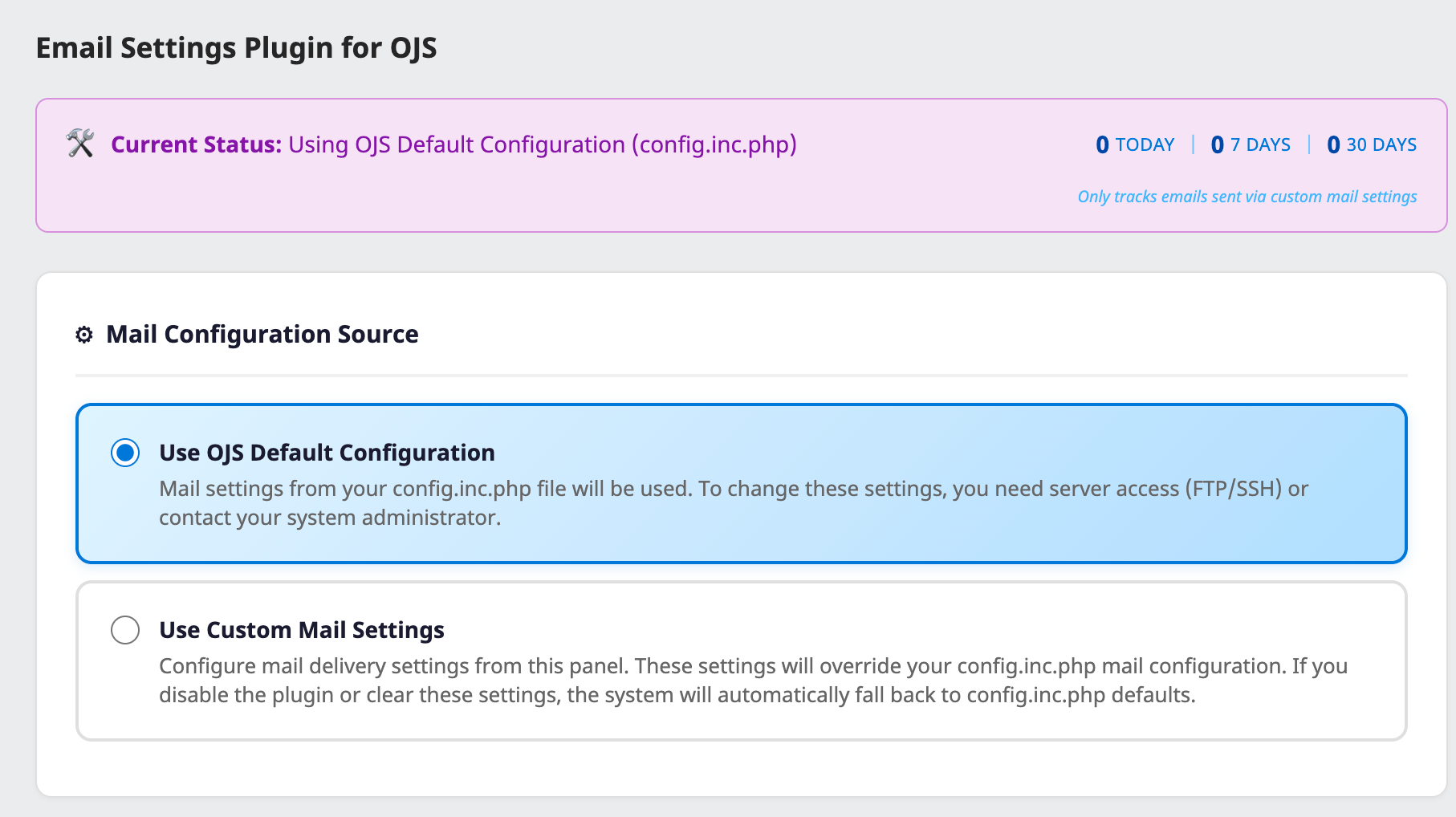
Manage OJS Email Settings from the Admin Panel: Email Settings Plugin

One of the most common issues OJS users face: email delivery.

In forums, support requests, and the OJS community, the most frequently asked questions are always the same:

  • “My journal isn’t sending emails, what should I do?”
  • “How do I configure Gmail SMTP?”
  • “I can’t edit config.inc.php, I don’t have server access”
  • “Can we set up different email addresses for each journal?”

We developed the Email Settings Plugin to solve these problems and make life easier for OJS administrators.


❌ The Old Way: Complex and Technical

To change email settings in OJS, you needed to:

  1. Connect to the server via FTP/SSH
  2. Find and edit the config.inc.php file
  3. Write SMTP parameters in the correct format
  4. Risk breaking your site if you make a mistake
  5. Repeat this process for every change

Result: A nearly impossible process for journal editors and managers without technical knowledge.


✅ The New Way: Easy Management from the Panel

With Email Settings Plugin:

  • No server access required — All settings are configured from the OJS admin panel
  • Visual interface — No complex configuration files, just form fields
  • Instant changes — Click Save, and it’s immediately active
  • Secure — Passwords are stored encrypted

🌟 Key Features

📧 Popular Service Presets

Ready-made settings for Gmail, Yandex, Office 365, and Zoho Mail. Just enter your email and password, and the plugin handles the rest.

Important notes like Gmail’s App Password requirement are automatically displayed.

🏢 Multi-Journal Support

This feature was requested by many publishers.

If you manage multiple journals in a single OJS installation, you can set different SMTP configurations for each:

  • Journal A → info@journala.com (Gmail)
  • Journal B → editor@journalb.com (Yandex)
  • Journal C → contact@journalc.com (Corporate SMTP)

Each journal sends emails from its own address.

📊 Simple Statistics

Track sent emails:

  • How many emails sent today
  • How many emails sent in the last 7 days
  • How many emails sent in the last 30 days

This lets you easily see if your email system is working.

✉️ Test Email

Send a test email immediately after saving your settings. See any issues instantly and fix them.

🔒 Security

  • CSRF protection
  • Passwords encrypted with AES-256
  • Only Site Admin and Journal Manager can access (Journal Editors cannot)

📬 Deliverability Recommendations

Information about SPF, DKIM, and DMARC. Guidance on DNS settings to prevent your emails from landing in spam folders.

Settings Page — Status & Configuration


Settings Page

SMTP Configuration & Service Presets


SMTP Configuration

Gmail Preset with App Password Notice


Gmail Preset

Yandex Mail Preset


Yandex Preset

Test Email & Deliverability Recommendations


Test Email


📥 Installation

  1. Download the .tar.gz file from GitHub Releases
  2. Go to OJS → Settings → Website → Plugins → Upload A New Plugin
  3. Enable the plugin
  4. Click the “Email Settings” link in the sidebar or access plugin settings

🆓 Free and Open Source

This plugin is provided free of charge under the GPL v3 license. We developed it as our contribution to the OJS community.

For installation support, customization, or OJS consulting: ojs-services.com


📎 Links


Made with ❤️ by OJS Services — Professional OJS hosting, themes, plugins and consulting for academic journals.

The post Email Settings Plugin for OJS first appeared on OPEN JOURNAL SYSTEM SERVICES.

ORCID iD and Phone Number at Registration: Plugin for OJS 3.3

February 9th 2026 at 4:12 am

If you manage an academic journal on OJS, you already know the problem: a new author registers, submits a manuscript — and then you realize their ORCID iD and phone number are missing from their profile. You send an email asking them to update their profile, wait for a response, and sometimes follow up again. This small gap in the registration workflow costs time for everyone involved.

Registration Fields is an open-source OJS plugin that closes this gap by adding ORCID iD and Phone Number fields directly to the user registration form.

The Problem

OJS stores both ORCID iD and phone number in user profiles. These fields exist in the system and are used by DOI registration, Crossref deposits, and editorial communication. However, OJS only allows users to fill in these fields after registration, through the profile editor. There is no built-in way to ask for this information during signup.

For journals that require ORCID iDs — an increasingly common policy — this creates an unnecessary extra step. Authors register, then must be reminded to go back and add their ORCID. For editorial offices that need phone numbers for communication, the same problem applies.

What the Plugin Does

The Registration Fields plugin adds two optional fields to the OJS registration form, positioned between the profile section and the login credentials section:

ORCID iD and Phone Number fields appear on the registration form, above the Login section.

Each field can be independently enabled or disabled, and each can be set as required or optional. The configuration is done through a simple settings panel accessible from the plugin management page:

The settings panel lets you enable, require, or disable each field independently. A debug mode is available for troubleshooting.

Values entered during registration are saved directly to the corresponding OJS profile fields — the same fields used by ORCID integrations, Crossref, and the editorial contact system. No new database tables are created; the plugin simply writes to what is already there.

Key Features

ORCID iD validation accepts three common input formats — bare identifier (0000-0000-0000-0000), full HTTPS URL, or HTTP URL — and normalizes all of them to the standard https://orcid.org/ format on save.

Phone number validation accepts international formats with country codes, supporting digits, spaces, plus signs, dashes, and parentheses.

Theme compatibility is handled through flexible pattern matching with a built-in fallback mechanism. The plugin works across OJS themes including Default, Manuscript, Bootstrap3, Health Sciences, JournalPlus, NIVO, and AXIS. If a theme uses an unusual HTML structure, the fields are still rendered before the form’s closing tag.

Debug mode can be enabled from the settings panel to write diagnostic information to the PHP error log. This helps identify exactly how the plugin is interacting with a particular theme, making it easy to troubleshoot without modifying any code.

Who Is This For?

  • Journals requiring ORCID iDs at submission — Collect them upfront instead of chasing authors after registration.
  • Editorial offices that communicate by phone — Have the number from day one.
  • Journal managers who want cleaner author profiles — Reduce incomplete registrations without adding manual follow-up steps.

Technical Details

The plugin integrates with OJS through its hook system — no core files are modified. It uses output filtering to inject fields into the registration form, server-side validation for all inputs, and a deferred save mechanism to ensure data is written after the user record is created. All input is sanitized and escaped, and the plugin includes CSRF protection for its settings form.

It is compatible with OJS 3.3.0.0 through 3.3.0.22 and PHP 7.4 through 8.2.

Installation

  1. Download the latest release from GitHub.
  2. In OJS, go to Settings → Website → Plugins → Upload a New Plugin.
  3. Upload the .tar.gz file and enable the plugin.
  4. Click Settings to configure which fields appear on the registration form.

The plugin is free, open-source (GPL v3), and available in English and Turkish.


Developed by OJS Services.

The post ORCID iD and Phone Number at Registration: Plugin for OJS 3.3 first appeared on OPEN JOURNAL SYSTEM SERVICES.

Login with Email Address in OJS: Email Login Plugin

January 30th 2026 at 1:06 pm

We frequently hear this complaint from journal managers using OJS: “Our users keep requesting password resets, but they haven’t actually forgotten their passwords!”

The root cause is simple: OJS requires a username to login. However, almost every website today allows login with an email address. Users naturally enter their email address in OJS and receive the “Invalid username or password” error.

This results in:

  • 📧 Unnecessary password reset requests
  • 😤 User frustration
  • ⏰ Wasted time for journal managers

The Solution: Email Login Plugin

We developed the Email Login Plugin to solve this problem. With this plugin, users can now login using either their username or email address.

How It Works

  1. User enters their email address in the login field
  2. The plugin automatically finds the username associated with that email
  3. Login proceeds normally

The user doesn’t notice any difference – they can simply login with their email address now!

Features

Email login – Users can now login with their email address
Username support – Existing behavior unchanged, username login still works
Automatic form update – Login form label changes to “Username or Email”
Secure – SQL injection protection and input validation
No core modifications – No issues with OJS updates
Bilingual support – English and Turkish


Installation

Installation takes just a few minutes:

  1. Download the .tar.gz file from GitHub releases
  2. Go to Settings → Website → Plugins in OJS admin panel
  3. Click Upload A New Plugin
  4. Select the downloaded file
  5. Enable “Email Login” under Generic Plugins

That’s it! Your users can now login with their email addresses.


Compatibility

Requirement Version
OJS 3.3.0 – 3.3.0.22+
PHP 7.3 or higher

Security

Security was a priority during development:

  • Prepared Statements protect against SQL injection attacks
  • Email addresses are validated and sanitized before database queries
  • Disabled accounts cannot login via email
  • Error messages don’t reveal whether an email exists in the system

Frequently Asked Questions

Q: Will existing username login continue to work?
A: Yes, nothing changes. Users can login with either username or email.

Q: Will the plugin break when I update OJS?
A: No, the plugin doesn’t modify core files. It’s unaffected by OJS updates.

Q: What happens if the same email is used for multiple accounts?
A: OJS already prevents the same email from being used for multiple accounts.


Download

📥 Download Email Login Plugin v1.1.0

📖 GitHub Repository


Support

For questions or issues with the plugin:

The post Login with Email Address in OJS: Email Login Plugin first appeared on OPEN JOURNAL SYSTEM SERVICES.

Bulk Plugin Manager for OJS

December 3rd 2025 at 10:34 pm

This free plugin for OJS 3.3.x simplifies plugin management, solves common problems, and saves you hours of work.


🎯 Why We Developed This Plugin

One of the most common issues OJS users face: “The Plugins page won’t load!”

This problem usually stems from version mismatches between the database and file system. When this happens, OJS’s standard interface completely freezes, leaving administrators helpless.

That’s exactly why we developed Bulk Plugin Manager.


✨ What Does It Do?

📊 Instant Status Overview

See your entire plugin status at a glance:

  • Your OJS version
  • Installed, active, and inactive plugin counts
  • Plugins awaiting updates
  • Problematic plugins

🔧 Automatic Problem Detection

The plugin automatically detects the following issues:

  • Sync issues: Database and file versions differ
  • Missing files: Database record exists but files are deleted
  • Version conflicts: Local version is higher than Gallery version

⚡ One-Click Solutions

Ready-made solution buttons for every problem:

  • Fix DB: Synchronizes database version with file
  • Clean DB: Removes orphan records
  • Install: Downloads missing files from Gallery
  • Update: Updates plugin to the latest version

🌍 Multi-Language Support

  • 🇬🇧 English
  • 🇹🇷 Türkçe

🚀 When Should You Use It?

1. When OJS Plugin Page Won’t Load

The most common scenario! When the OJS plugin page freezes due to database-file mismatch, Bulk Plugin Manager comes to the rescue. You can access it directly via URL:

https://yoursite.com/index.php/journal/bulkPluginManager

2. When You Need to Update Multiple Plugins

In the standard OJS interface, you have to update plugins one by one. With Bulk Plugin Manager, you can select multiple plugins and update them with a single click.

3. When You Need Plugin Cleanup

Ideal for detecting and cleaning up “ghost” records left in the database from deleted plugins.

4. For Quick Status Check

Get instant summaries with dashboard cards and spot issues immediately.


📑 Tabs and Their Functions

Tab What It Shows
🔌 Installed All installed plugins. Shows DB and file versions side by side.
🔧 DB Fix Required Plugins where database version is higher than Gallery. Requires fixing.
🔄 Sync Issues Plugins where DB and file versions differ. Can cause OJS page to freeze.
📁 Missing Files Plugins with deleted files but remaining DB records.
⬆️ Updates Plugins awaiting updates.
📦 Available Not yet installed, available plugins from Gallery.
⚠️ Newer Installed Local version is newer than Gallery. Usually not a problem.
Not in Gallery Custom plugins not found in PKP Gallery.

Each tab includes a helpful description at the top explaining what it contains and what actions are available.


🔍 Filters

The Installed tab has 5 filters to narrow down plugins:

Filter Shows
All All plugins
Active Only active ones
Inactive Only inactive ones
Sync Issues Plugins where DB ≠ File version
Missing Files Plugins without files on server

🛠️ Action Buttons

🔧 Fix DB

Synchronizes database version with file version. Use when:

  • OJS plugin page won’t load
  • Plugin is stuck in “current=0” error
  • Version mismatch after manual intervention

🗑️ Clean DB

Deletes all database records for the plugin. Use when:

  • You manually deleted plugin files
  • Plugin appears in list but has no files

📦 Install

Downloads and installs the plugin from PKP Gallery. Use when:

  • You want to install a new plugin
  • You want to re-download missing files

⬆️ Update

Downloads and updates to the latest version from Gallery.


🐛 Common Problems and Solutions

Problem 1: OJS Plugin Page Won’t Load

Cause: Database version doesn’t match file version.

Solution:

  1. Access Bulk Plugin Manager via URL
  2. Go to “Installed” tab
  3. Select “Sync Issues” filter
  4. Click “Fix DB” button on each row

Problem 2: Deleted Plugin Still in List

Cause: Files were deleted but database records remain.

Solution:

  1. Go to “Installed” tab
  2. Select “Missing Files” filter
  3. Click “Clean DB” button

Problem 3: Plugin Won’t Update

Cause: Local version is higher than Gallery version.

Solution:

  1. Go to “DB Fix Required” tab
  2. Reset version with “Fix DB”
  3. Then update normally

📥 Installation

  1. Download the plugin from GitHub
  2. Extract to /plugins/generic/ folder
  3. OJS Admin Panel > Website Settings > Plugins
  4. Generic Plugins > “Bulk Plugin Manager for OJS” → Enable
  5. Click “🔌 Bulk Plugin Manager” link in the sidebar

Alternative Access:

https://yoursite.com/index.php/JOURNAL/bulkPluginManager

📥 Download

GitHub: github.com/ojs-services/ojs-bulk-plugin-manager

Latest Release: Releases


📌 Important Notes

⚠️ Backup First: We recommend backing up before performing database operations.

👤 Permissions: Only Site Administrator and Journal Manager roles can access.

🔒 OJS 3.4+ Safety: This plugin is only compatible with OJS 3.3.x. If installed on OJS 3.4 or higher, it automatically disables itself.

🌐 Internet Required: Plugin information is fetched from PKP Gallery.


🤝 Support

For questions or suggestions:


📄 License

This plugin is provided free of charge under the GNU General Public License v3.

The post Bulk Plugin Manager for OJS first appeared on OPEN JOURNAL SYSTEM SERVICES.

DNB Export Plugin

September 30th 2025 at 4:04 pm

DNB Export Plugin: Strengthening OJS Integration with National Libraries

Open Journal Systems (OJS) has become the world’s most popular platform for managing and publishing academic journals. One of the key reasons behind its success is the rich ecosystem of plugins and integrations that connect journals with indexing services, archiving systems, and research infrastructures worldwide. One such plugin that deserves spotlight is the DNB Export Plugin, maintained by the OJS community (GitHub – ojsde/dnb).

This plugin allows journals to seamlessly deposit their metadata and publications into the Deutsche Nationalbibliothek (DNB) – the German National Library. With this connection, OJS journals benefit from:

  • Increased visibility through national library catalogs

  • Reliable archiving of scholarly content for the long term

  • Stronger compliance with international publishing standards

The DNB integration is a great example of how OJS goes beyond being a journal management tool. It is part of a global network, linking research with repositories, libraries, and indexing platforms. For editors and institutions, this means less manual work, greater discoverability, and a trusted place in the international scholarly landscape.

At OJS-Services, we support journals in making the most of these integrations – from setup to ongoing workflows – so that your research reaches the widest possible audience.

The post DNB Export Plugin first appeared on OPEN JOURNAL SYSTEM SERVICES.

iThenticate Plagiarism Detector Plugin for OJS

September 11th 2025 at 11:57 pm

The latest iThenticate Plagiarism Detector Plugin (versions 1.0.7.0 and 1.0.8.0) brings powerful improvements for journals using OJS:

Key Highlights

  • Control Over File Checks: Editors can choose which files to submit for plagiarism detection—no more unnecessary checks on title pages or forms.

  • Automatic or Manual Submission: Enable automatic submission for all files, or switch to manual mode to select only the main manuscript.

  • Integrated Reports in OJS: Similarity scores and detailed reports can be viewed directly within the OJS interface.

  • EULA Compliance: Authors and editors must agree to the iThenticate End User License Agreement before checks are performed, with multilingual support.

  • iThenticate 2.0 Support: The plugin now requires API credentials. Journals must upgrade from username/password to API key authentication.

As shown in the screenshot, journal managers and site administrators can configure advanced similarity check settings directly within the iThenticate plugin. Options include excluding quotes, bibliographies, citations, abstracts, or methods from the analysis, as well as setting thresholds for small matches. These settings give editors more control and ensure that plagiarism reports focus on the most relevant parts of a manuscript.

Download: https://github.com/pkp/plagiarism

Why It Matters

These updates streamline editorial workflows, ensure research integrity, and give journals greater flexibility in managing plagiarism checks.

Need help upgrading OJS or its plugins?
We provide full support for OJS updates, plugin configuration, and integration. Contact us today to make sure your journal runs smoothly with the latest features.

The post iThenticate Plagiarism Detector Plugin for OJS first appeared on OPEN JOURNAL SYSTEM SERVICES.

OJS Blog Plugin

August 23rd 2025 at 2:29 am

OJS Blog Plugin: Bring Editorial Voice to Your Journal

Academic journals are no longer just platforms for publishing articles. Staying relevant today means keeping readers engaged, sharing timely updates, and building a stronger editorial voice within the scholarly community. This is exactly where the OJS Blog Plugin comes in — transforming your journal into a hub of communication and interaction.

With this plugin, editors and administrators can go beyond research articles to share comments, videos, journal news, editorial notes, academic events, and publishing tips. It allows you to maintain your journal’s academic identity while offering a more dynamic, accessible, and interactive experience for your community.

The OJS Blog plugin brings a powerful and flexible blogging system to Open Journal Systems (OJS).
It enables editors and administrators to publish posts, share updates, and engage readers beyond scholarly articles.

Key Features

  • Post Management: CKEditor integration, featured & inline images, draft/published/archived status, SEO-friendly slugs & metadata
  • Categories: Categories, filtering with post counts, safe reassignment on delete
  • Layouts & Appearance: Single or double column layouts, top/left category menus, theme-friendly CSS styling
  • Multi-Language Support: English & Turkish included, fully synchronized with OJS locales
  • Performance & Security: DAO-compliant, optimized queries, caching, CSRF & XSS protection, secure file uploads

👉 [Buy Now] – [DEMO]

Why Choose OJS Blog?

This plugin is ideal for journals that want to:

  • Publish announcements, news, congresses, conferences, seminars, and editorial updates
  • Engage readers with insightful blog posts
  • Improve visibility with SEO-friendly content
  • Provide a more dynamic user experience alongside research articles

License & Support

  • License Type: Commercial Proprietary License
  • Scope: Single Journal License, Multi-Journal License
  • Support: Free technical support included
  • Special Offer: Included free with OJS Hosting Advanced Pro and OJS Hosting Ultimate Pro packages

🔗 View OJS Blog Plugin – License Terms

Compatibility

Works seamlessly with OJS 3.3+ versions.

🛒 Get Started Today

Bring your editorial voice to life and keep your community engaged with the OJS Blog Plugin.

👉 [Buy Now]

📌 The OJS Blog plugin is compatible with OJS 3.3+ versions.

OJS Blog Plugin – Screenshots & Feature Preview

OJS Blog Plugin

You can choose to display the posts in a single column or two columns, and place the categories either at the top of the page or on the left side, depending on your preference.

Blog Post Example
An example blog post with indexing updates and rich text formatting.

Blog Category View
Easily organize your content by creating categories such as Journal News, Editorial Notes, or Publishing Tips. Readers can quickly filter posts by category, making it simple to find the information that matters most to them.

Blog Management Panel – Posts
The administrative panel for managing blog posts with options to add, edit, or delete entries.

Blog Management Panel – Categories
Manage categories such as Journal News, Editorial Notes, and Academic Events directly from the admin panel.

Blog Settings
Comprehensive settings panel for customizing layout, categories, language, cover images, and display options.

The post OJS Blog Plugin first appeared on OPEN JOURNAL SYSTEM SERVICES.

Comprehensive List of OJS Plugins

August 2nd 2025 at 11:26 pm

Open Journal Systems (OJS) is an open-source journal management and publishing platform developed by the Public Knowledge Project (PKP). Trusted by thousands of academic journals worldwide, OJS offers a comprehensive, customizable environment to manage every aspect of scholarly publishing — from submission and peer review to publication, indexing, and archiving.

While OJS provides a robust set of built-in features — including role-based editorial workflows, issue management, user registration, SEO optimization, DOI integration, and XML exports — one of its greatest strengths lies in its modular plugin architecture.

Why Are Plugins Important?

Plugins extend OJS functionality and allow journals to tailor the system to their specific needs. Whether your focus is discoverability, editorial efficiency, analytics, or user experience, plugins make it possible to enhance your publishing platform without modifying the core software.

Here are just a few areas where OJS plugins make a real difference:

  • Indexing and Visibility: Seamless integration with platforms like Google Scholar, DOAJ, Crossref, and PubMed boosts your journal’s discoverability and academic reach.

  • Design and Accessibility: Themes, language toggles, and visual enhancements improve the journal’s appearance and user-friendliness.

  • Statistics and Reporting: Plugins can provide detailed insights into views, downloads, citations, and subscriptions to support editorial decisions and strategic planning.

  • Security and Archiving: With plugins for backup, virus scanning, and integration with preservation networks like PKP PN and Portico, your journal’s content stays secure and permanently accessible.

  • User Experience: Enhance your site with social sharing tools, suggested articles, improved submission workflows, payment systems, and more.

In short, plugins not only add technical capabilities but also empower journal managers and editors to run more efficient, visible, and reader-friendly publications — aligned with global publishing standards.

If you need help with academic journal setup, OJS hosting, system upgrades, technical support, plugin installation, or even custom plugin development, feel free to contact us — we’re here to support your publishing goals every step of the way.

Comprehensive List of OJS Plugins (With Explanations)

Below is a full list of available plugins for OJS, along with detailed descriptions of what each plugin does, who it’s for, and how it can benefit your journal. Whether you’re just starting or managing a well-established publication, this list serves as a valuable reference to help you take full advantage of the OJS ecosystem.

Plugin NameExplanation
AcronThe Acron plugin simulates cron-like behavior by executing scheduled tasks during user interactions. It enables automatic processing of routine maintenance such as sending email reminders, log rotations, and statistics updates without requiring server-level cron setup, making it easier to manage hosting environments without shell access.
Allowed UploadsAllowed Uploads plugin allows journal managers to control the file types users can upload during manuscript submission. This ensures that only safe and relevant file formats are accepted, reducing the risk of malicious content and maintaining a clean and consistent submission process across different submissions and users.
Announcement BlockAnnouncement Block plugin provides a sidebar widget to display recent announcements. Journal managers can configure how many announcements are shown. This is useful for keeping readers informed about new issues, editorial updates, calls for papers, or any important journal-related news directly on the front page.
Announcement FeedAnnouncement Feed plugin generates RSS and Atom feeds for published announcements. This allows users to subscribe and receive updates automatically in their feed readers. It's useful for disseminating journal news efficiently and reaching audiences beyond regular website visitors through web syndication technologies.
ArkThe Ark plugin enables the generation and management of ARK (Archival Resource Key) identifiers for issues, articles, and galleys. These persistent identifiers improve long-term access to academic content, helping institutions and libraries manage digital objects in an interoperable and stable way.
Articles ReportThe Articles Report plugin generates a downloadable CSV spreadsheet that includes detailed metadata for all articles in the system—published or unpublished. Information includes titles, abstracts, author names, and submission status, making it an invaluable tool for journal managers conducting audits, exporting data, or reviewing editorial workflows.
AkismetAkismet is an anti-spam plugin that checks new user registrations against the Akismet database to detect suspicious or spammy behavior. Useful especially in open registration environments, this plugin helps prevent bot accounts and maintain a cleaner, more secure user base. An Akismet API key is required to use it.
Author RequirementsThe Author Requirements plugin allows journals to configure which author fields are required or optional during submission. For example, journals that don't require an ORCID or email for every contributor can make those fields optional, enabling more flexible submission policies without compromising metadata completeness.
Authors HistoryAuthors History plugin adds a new tab to the Publication section of each submission, listing all previous submissions by the same contributor. This provides editors with historical context when evaluating new submissions, aiding decisions on review assignments, author reputation, and editorial workload distribution.
BackupThe Backup plugin enables administrators to generate full backups of their OJS installations, including files, database content, and configurations. This is essential for disaster recovery and system migration tasks. Backups can be downloaded and stored offline for safekeeping, helping maintain business continuity.
Bepress Import (unvetted)Bepress Import plugin helps journals transition from the Bepress Digital Commons platform to OJS. It maps and imports article metadata, full text, and issues into the OJS framework. This simplifies platform migration and allows journals to preserve their existing content and structure in a new environment.
Better PasswordThe Better Password plugin enhances user account security by enforcing stricter password requirements. It allows journal administrators to define password rules, such as minimum length, use of special characters, or restrictions on reused passwords, improving overall data protection and reducing account vulnerabilities.
Bibi Epub ViewerBibi Epub Viewer plugin embeds EPUB-format galleys directly within the article page using the Bibi EPUB reader. This allows readers to enjoy a smooth, book-like reading experience within their browsers, eliminating the need to download files and enhancing accessibility across devices.
Bootstrap3 ThemeBootstrap3 Theme provides a foundational Bootstrap 3-based theme for OJS, giving developers a flexible framework for customizing the journal's look and feel. It's intended for use by those with knowledge of HTML, CSS, and JavaScript who want to build a completely unique visual style.
Browse BlockBrowse Block plugin adds a sidebar widget that enables readers to navigate articles by section, such as Research Articles, Reviews, or Editorials. It enhances user experience by improving content discoverability and supporting thematic exploration within journal issues.
Browse By SectionThe Browse By Section plugin allows journal administrators to add journal sections (e.g., Articles, Reviews) to the navigation menu. This helps readers browse all content from specific sections across multiple issues, providing a more organized and accessible way to explore the journal's archive.
Citation Style LanguageThe Citation Style Language plugin enables article citation exports in multiple formats such as APA, MLA, or Chicago. Readers can copy citations in their preferred style, facilitating easier referencing in academic writing. This is especially useful for researchers and students who need to cite articles quickly.
Clam Antivirus Plugin for OJSClam Antivirus Plugin integrates ClamAV antivirus scanning into the OJS submission process. All uploaded files are scanned for viruses, and any infected files are blocked. This provides an important layer of security for the journal, protecting both editorial staff and readers from malware.
Classic ThemeThe Classic Theme plugin delivers a traditional scholarly appearance for OJS websites, emphasizing high-contrast fonts and minimalist design. Inspired by classic literary publications, it appeals to journals aiming for a timeless and readable aesthetic, especially in the humanities and social sciences.
COinSThe COinS plugin (ContextObjects in Spans) embeds machine-readable metadata into article pages using the OpenURL standard. This allows citation management tools like Zotero to automatically recognize and import article metadata, making scholarly referencing and organization easier for researchers.
Content AnalysisThe Content Analysis plugin (specific to OPS) scans uploaded submissions to detect missing metadata such as titles or abstracts. This helps ensure data quality before a submission progresses through the workflow. Editors can catch issues early and request corrections from authors if needed.
Control Public FilesControl Public Files plugin gives managers greater control over who can upload files to the public directory and what file types are allowed. This can reduce clutter and improve site security by preventing the upload of unauthorized or potentially unsafe files by users.
COUNTER ReportsCOUNTER Reports plugin generates CSV spreadsheets of journal usage data based on the COUNTER standard. Metrics include article views, downloads, and other key statistics. Though it does not make a journal fully COUNTER-compliant, it offers valuable insights for internal reporting and analysis.
Crossref Reference Linking PluginCrossref Reference Linking Plugin automates the process of checking references in submitted articles against Crossref’s database. It attempts to match and assign DOIs to references, ensuring citations are properly linked. This improves scholarly connectivity and enhances the accuracy of metadata deposits.
CrossRef XML Export PluginCrossRef XML Export Plugin facilitates the export of article, issue, and galley metadata in Crossref XML format. This is critical for journals assigning DOIs through Crossref and allows for either manual submission or automated deposits using Crossref credentials.
Custom Block ManagerThe Custom Block Manager plugin enables administrators to create, edit, and manage custom sidebar blocks directly from the OJS dashboard. These blocks can include text, images, or HTML content, offering flexibility for displaying announcements, banners, or additional journal information in the sidebar area.
Custom Header PluginThe Custom Header Plugin allows the insertion of custom HTML or JavaScript into the section of journal pages. This is useful for integrating third-party tools like analytics, chat widgets, or custom CSS, enabling enhanced customization beyond what's offered through themes alone.
Custom LocaleCustom Locale plugin allows journal managers to edit language keys (labels, buttons, messages) used across the OJS interface. This is ideal for journals that want to tailor terminology to specific audiences or make interface language more intuitive for their users, without modifying core files.
Datacite export for OJSThe Datacite Export plugin enables exporting or registering article, issue, and galley metadata in the DataCite format. This is crucial for journals that register DOIs via DataCite, ensuring proper metadata formatting for indexing and long-term discoverability in global repositories.
Datacite export for OMPDatacite export for OMP extends DataCite integration to support monographs and book chapters. It allows presses using OMP to assign and register DOIs for long-form publications with chapter-level granularity, helping scholarly publishers maintain consistent identifiers across formats.
DataverseThe Dataverse plugin integrates Dataverse data repositories with OJS and OPS. Authors can submit research data as part of their manuscript, enhancing reproducibility and transparency. Reviewers and readers can access datasets directly from article pages or submission views if enabled.
DC Metadata FormatDC Metadata Format plugin ensures article metadata is structured in accordance with the Dublin Core standard. This supports compatibility with various digital libraries and indexing systems, making OJS journal content more discoverable through standardized metadata protocols.
Default ThemeThe Default Theme is the out-of-the-box theme included with OJS/OMP/OPS. It emphasizes simplicity and accessibility, following WCAG standards for contrast, navigation, and readability. Suitable for journals that want a professional, clean design without custom theming efforts.
Default TranslationDefault Translation plugin provides fallback support to English if any translation key is missing in the selected language. This prevents incomplete or broken interfaces when using partially translated locales, ensuring users always see readable content even with incomplete translations.
Developed By BlockDeveloped By Block plugin adds a customizable 'Developed By' link in the sidebar, usually pointing to the OJS or PKP website. It offers a small branding element and is often used for crediting platform development or promoting the use of open-source publishing tools.
DisqusThe Disqus plugin integrates the Disqus commenting system into article abstract pages. Readers can post comments and engage in discussion, fostering reader-author interaction. It's especially useful for journals that encourage post-publication peer review or want to create a more dynamic and engaged readership.
DOAJ Export PluginThe DOAJ Export Plugin facilitates the export and delivery of journal articles to the Directory of Open Access Journals (DOAJ). Journals with a DOAJ API Key can automate this process. This helps enhance visibility and credibility by ensuring content is discoverable on one of the major open access indexes.
DOIThe DOI plugin allows journals to assign Digital Object Identifiers (DOIs) to their published content such as issues, articles, and galleys. It supports integration with multiple DOI registration agencies (Crossref, DataCite, Medra), making scholarly content easily citable and permanently findable.
DOI to mEDRA XML Export and RegistrationThe DOI to mEDRA XML Export and Registration plugin enables export of metadata in ONIX for DOI format for registration with mEDRA. This plugin is tailored for European DOI management needs and offers integration with mEDRA's DOI registration services for scholarly publishing.
DOI to OP DOI RA XML Export and RegistrationThe DOI to OP DOI RA plugin facilitates export of article and issue metadata in ONIX4DOI format for DOI registration with OP DOI RA. It serves journals that register DOIs through OP, streamlining the technical process of metadata submission and identifier management.
DRIVERThe DRIVER plugin extends the OAI-PMH protocol to conform with DRIVER Guidelines 2.0. This helps journals become DRIVER-compliant, which is necessary for inclusion in certain European repository networks and supports improved metadata harvesting and interoperability.
Dublin Core IndexingThe Dublin Core Indexing plugin embeds Dublin Core metadata directly into article views. This improves indexing by digital libraries and search engines. It ensures that title, creator, subject, and other metadata elements are properly tagged for enhanced content discovery.
Email Issue Table of ContentsThe Email Issue Table of Contents plugin automatically adds the issue’s table of contents to the email notification sent out when a new issue is published. This helps readers see the full content lineup at a glance, improving engagement and encouraging traffic to newly published material.
EPUB viewerThe EPUB viewer plugin allows EPUB-formatted galleys to be viewed directly in the browser using the epub.js library. This makes journal content more accessible on mobile devices and tablets, enhancing the reading experience for users who prefer e-book formats over PDFs.
Forthcoming articles (unvetted)The Forthcoming Articles plugin allows journals to publish and display individual articles before an issue is finalized. These articles are shown in a special ‘Forthcoming’ section rather than in the issue archive. This supports early visibility for accepted manuscripts and faster dissemination of research.
FundingThe Funding plugin allows authors to provide detailed funding information related to their submissions. It pulls from the Crossref Funder Registry and integrates this data into article metadata for indexing and export. This supports transparency and compliance with funder reporting requirements in open access publishing.
Google AnalyticsGoogle Analytics plugin integrates Google’s website tracking service with OJS. It helps journal managers track user visits, behavior, popular articles, and traffic sources. This is valuable for assessing reader engagement, refining site layout, and optimizing content visibility through analytics insights.
Google Scholar IndexingGoogle Scholar Indexing plugin enhances a journal’s visibility in Google Scholar by ensuring that metadata is properly formatted and discoverable. It helps ensure articles appear in search results, significantly improving discoverability, citations, and the academic impact of published research.
Health Sciences ThemeThe Health Sciences Theme is a professional and clean theme optimized for health and medical journals. It prioritizes legibility, accessibility, and usability, offering a neutral yet informative layout that emphasizes article content while maintaining institutional trust and credibility.
HoneypotHoneypot plugin is an anti-spam measure that works by inserting a hidden field into registration forms. Bots that automatically fill all fields—including hidden ones—are blocked, while human users proceed normally. It helps reduce spam accounts without disrupting legitimate registrations.
HTML Article GalleyHTML Article Galley plugin provides a built-in browser viewer for HTML-formatted article galleys in OJS. It improves user experience by displaying articles within the page rather than requiring downloads, making content more accessible and preserving layout and links from original HTML.
HTML Monograph FileHTML Monograph File plugin is designed for OMP and allows monograph files formatted in HTML to be rendered directly in the browser. This improves accessibility and readability, especially for long-form works, without forcing users to download files.
Hypothes.isThe Hypothes.is plugin integrates with the Hypothes.is annotation service. It allows readers to comment on and highlight parts of the article, particularly useful for public peer review, educational use, or reader engagement. Works best with HTML galleys; PDF support is limited.
Immersion ThemeImmersion Theme offers a visually striking experience, emphasizing readability and branding. Journals can customize header images and colors by section. It’s well-suited for journals that want a modern, attractive design that stands out while still supporting strong content legibility.
Information BlockThe Information Block plugin provides sidebar sections labeled 'For Readers', 'For Authors', and 'For Librarians'. These are editable via the journal’s setup area and offer essential orientation for each type of user, guiding them to appropriate resources and instructions.
Inline Html GalleyInline HTML Galley plugin improves how HTML galleys are displayed by embedding them directly within the article view page instead of using iframes. This results in cleaner rendering, better responsiveness, and improved accessibility for readers, especially on mobile devices and screen readers.
iThenticateThe iThenticate plugin integrates OJS with the iThenticate plagiarism detection service. All submission files can be automatically scanned to ensure originality. It helps editors detect academic misconduct early, maintain publication integrity, and meet institutional and ethical publishing standards.
JATS TemplateJATS Template plugin generates a basic JATS XML file based on the article metadata and available content. This is useful when full JATS XML is unavailable. Combined with the OAI JATS plugin, it ensures that journals can expose machine-readable metadata for indexing and archiving.
Keyword Cloud PluginThe Keyword Cloud Plugin displays a visual cloud of keywords on the sidebar, where frequently used terms appear larger. This improves discoverability and helps readers identify common themes in published articles. Clicking a keyword redirects users to a filtered list of related content.
Language Toggle BlockLanguage Toggle Block plugin adds a widget that lets readers switch between enabled interface languages. It’s especially useful for multilingual journals, making it easier for users to browse content in their preferred language directly from the sidebar.
Lens Viewer for Monographs and Journal ArticlesLens Viewer plugin provides an HTML viewer for JATS XML-formatted articles and monographs using eLife Lens. It allows readers to interact with structured content—figures, tables, references—inline and offers a modern reading experience for journals distributing XML-based articles.
Lucene/Solr PluginLucene/Solr Plugin adds support for indexing OJS content with Apache Solr or Lucene. This improves search accuracy and performance, especially in large multi-journal systems. Setup is complex and recommended only for advanced users or journals with high content volume.
Make a Submission BlockMake a Submission Block plugin provides a sidebar button that links directly to the submission page. It streamlines navigation for potential authors and encourages more submissions by keeping the submission entry point visible across the journal site.
Manual Fee PaymentManual Fee Payment plugin enables administrators to record fee payments received outside the system (e.g., bank transfer, in-person). This is useful for journals using alternative payment channels and allows them to maintain accurate financial records within OJS.
Manuscript (Default child theme)The Manuscript (Default Child Theme) applies a boxed layout that mimics a printed page. It’s a simple and clean design suited for scholarly content, preserving readability while giving a formal and structured appearance to journal articles.
MARC Metadata FormatThe MARC Metadata Format plugin structures metadata according to the MARC standard, commonly used by libraries. This enhances interoperability with library catalog systems, ensuring that journal content can be easily discovered, cataloged, and preserved in academic and public libraries.
MARC21 Metadata FormatThe MARC21 Metadata Format plugin outputs metadata in the MARC21 format, a variant of MARC widely used in the United States and internationally. It's helpful for libraries needing structured, machine-readable metadata for inclusion in union catalogs and bibliographic databases.
Material ThemeMaterial Theme plugin offers a frontend based on the Material Design framework (via MDBootstrap). It introduces a modern, card-based interface with interactive buttons and shadows. Ideal for journals seeking a contemporary appearance that emphasizes readability and usability.
MatomoMatomo plugin integrates the Matomo analytics platform (formerly Piwik) with OJS. Journals can monitor site traffic, visitor behavior, and article performance in a privacy-conscious environment. It’s a powerful alternative to Google Analytics with self-hosting capabilities.
Most readMost Read plugin adds a sidebar block that displays the top five most-viewed articles over the past week. Each entry includes the number of views, helping readers discover popular content and offering insight into trending topics within the journal.
Native XMLNative XML plugin allows import and export of article and issue content using OJS’s native XML schema. It’s commonly used for migrations, backups, and bulk publishing workflows. This plugin is essential for interoperability between different OJS instances and for long-term archiving.
OAI JATSThe OAI JATS plugin exposes article metadata in JATS XML format via the OAI-PMH protocol. While it does not generate JATS XML itself, it serves journals that already have JATS content and want to make it accessible for harvesting by archives and repositories.
ONIX 3.0 Monograph Export PluginONIX 3.0 Monograph Export Plugin exports monograph metadata in ONIX 3.0 format, which is used in the publishing industry for book distribution. It's especially relevant for OMP users and helps presses share metadata with distributors, libraries, and catalogs.
Open GraphThe Open Graph plugin inserts Open Graph tags into article and issue pages, enabling proper previews when links are shared on social media. It enhances how journal content appears on platforms like Facebook or Twitter, potentially increasing user engagement and visibility.
OpenAIREOpenAIRE plugin helps journals comply with OpenAIRE metadata standards and supports enhanced discoverability within European research infrastructure. It adds project IDs to metadata and extends OAI-PMH to meet OpenAIRE guidelines, promoting integration with EU-funded research systems.
OpenID AuthenticationThe OpenID Authentication plugin allows users to log in using third-party authentication providers like Google, Microsoft, ORCID, or Apple ID. It simplifies account creation and login, improves security, and is especially useful for journals that attract international authors and reviewers.
ORCID ProfileThe ORCID Profile plugin enables users to connect their ORCID iD with their OJS account and automatically import their public profile information. This ensures accurate author identification, supports metadata enrichment, and complies with funder and indexer requirements for persistent researcher identifiers.
PaperbuzzPaperbuzz plugin displays alternative metrics (altmetrics) on article pages, such as social media mentions, blog posts, and shares. It uses Crossref Event Data to provide free metrics, giving editors and authors insight into the broader impact and attention their research is receiving.
PayPal Fee PaymentPayPal Fee Payment plugin allows journals to collect payments for article processing charges (APCs), subscriptions, or other fees via PayPal. The plugin facilitates secure, real-time payment processing and is ideal for journals with monetized publishing models or membership structures.
PDF.JS PDF ViewerPDF.JS PDF Viewer plugin provides an in-browser viewer for PDF galleys using Mozilla’s PDF.js. It enhances accessibility by eliminating the need to download files and ensures cross-platform compatibility, offering users a consistent experience regardless of their device or browser.
PKP Usage Statistics ReportThe PKP Usage Statistics Report plugin exports monthly usage data including homepage visits, article views, and file downloads. It can also provide geographic statistics when configured. These reports are essential for journal performance analysis and reporting to stakeholders.
PKP PNPKP PN plugin automates the preservation of published journal content in the PKP Preservation Network. It ensures long-term archiving and protection against data loss. This plugin is essential for compliance with preservation policies and institutional archiving requirements.
PlauditPlaudit plugin adds a widget to article pages that enables peer endorsements. Scholars can publicly approve research with short, structured comments. This supports open peer evaluation, improves reader confidence, and complements traditional citation-based impact metrics.
Plugins update notificationPlugins update notification plugin alerts administrators when installed plugins have updates available in the Plugin Gallery. It ensures that plugins remain secure and up-to-date, reducing the risk of bugs or vulnerabilities in journal installations.
Plum AnalyticsPlum Analytics plugin adds PlumX Metrics to article pages, including citations, usage, captures, mentions, and social media activity. This gives authors and editors a more comprehensive view of article reach and performance beyond traditional citation counts.
PorticoThe Portico plugin allows journals to export article and issue metadata for preservation in Portico, a digital preservation service. This helps safeguard scholarly content against loss due to system failure or obsolescence and ensures long-term accessibility in trusted archival networks.
Pragma ThemePragma Theme plugin offers a minimalist design inspired by classic journal tables of contents. It uses a bold monochrome palette and structured layout, making it suitable for academic publications that prefer a clean, typographic focus over graphic-heavy presentations.
Public Identifier ResolverThe Public Identifier Resolver plugin creates URLs that resolve DOIs, ARKs, or other public identifiers used within the journal. It facilitates metadata lookups and improves user navigation by allowing persistent links to specific issues, articles, and galleys.
Publons Reviewer RecognitionPublons Reviewer Recognition plugin integrates with Publons to allow reviewers to receive recognition for their peer review work. It helps journals support reviewer motivation and transparency by enabling seamless export of review activity to Publons profiles.
PubMed XML ExportPubMed XML Export plugin allows journals indexed in MEDLINE to export article metadata in the format required by PubMed. It supports structured XML output, helping biomedical journals comply with National Library of Medicine standards for metadata submission.
PURLThe PURL plugin supports assignment of Persistent Uniform Resource Locators (PURLs) to issues, articles, and galleys. It ensures stable, redirectable URLs that can withstand changes in web structure, maintaining access to digital resources over time.
QuickSubmitQuickSubmit plugin allows editors and journal managers to bypass the standard editorial workflow and directly submit articles to the system. It’s useful for importing legacy content, handling conference proceedings, or fast-tracking accepted articles into production.
Recommend Articles by AuthorRecommend Articles by Author plugin displays other articles from the same author(s) on the article view page. This encourages deeper engagement with a researcher's work and helps readers find related studies by the same contributor within the same journal.
Recommend Similar ArticlesRecommend Similar Articles plugin suggests related articles based on keywords, titles, or abstracts. Displayed on the article landing page, this helps readers discover more relevant content, increasing engagement and time spent on the journal site.
Registration NotificationRegistration Notification plugin sends configurable emails to designated addresses whenever a new user registers. This keeps editorial teams or site administrators informed about community growth and can help with user vetting and onboarding processes.
Research Organization Registry(ROR)The Research Organization Registry (ROR) plugin allows journals to fetch and associate institutional affiliations using the ROR database. When authors enter their institution, it offers auto-suggestions. This ensures consistency and accuracy in organizational metadata across submissions.
Returning Author ScreeningReturning Author Screening plugin is used mainly in OPS. It allows authors who have already published at least one submission to self-publish new work with less editorial intervention. It's helpful in preprint workflows where speed is prioritized for trusted contributors.
ReviewerCreditsReviewerCredits plugin integrates OJS with ReviewerCredits, a platform that certifies and quantifies peer review work. It helps reviewers receive recognition for their contributions and journals maintain a transparent and reward-based review system.
Review ReportReview Report plugin generates a downloadable CSV report listing review assignments. It includes reviewer names, completion status, dates, and recommendations. Useful for editorial audits, reviewer performance tracking, and transparency in the peer review process.
RFC1807 Metadata FormatRFC1807 Metadata Format plugin structures metadata using the RFC1807 format. This format was historically used in libraries and online services for describing technical documents. It enhances compatibility with systems that still rely on RFC1807 metadata schemas.
SciELO Submissions ReportSciELO Submissions Report plugin creates a report tailored to SciELO’s requirements. It exports submission data in a format expected by the SciELO indexing platform, which is widely used in Latin American and developing countries’ scholarly ecosystems.
Scopus/Crossref CitationsScopus/Crossref Citations plugin fetches and displays citations for a given article using Crossref, Scopus, and optionally Google Scholar or PubMed. This plugin enriches article pages with citation counts and links, boosting academic visibility and author prestige.
ShariffShariff plugin adds privacy-compliant social media sharing buttons to article and issue pages. Unlike traditional share buttons, Shariff prevents tracking until a user interacts, complying with data privacy laws like GDPR while enabling content dissemination.
ShibbolethShibboleth plugin integrates with Shibboleth Single Sign-On systems. It enables users from academic institutions to log in using their institutional credentials, streamlining access and improving integration in university environments with federated identity systems.
SitesearchSitesearch plugin enhances search capabilities across multi-journal installations by enabling site-wide search. It returns results from all hosted journals, not just the one where the query was submitted. Useful for portal-style publishing platforms or institutional repositories.
Subscription BlockThe Subscription Block plugin displays a sidebar box with subscription-related information. It's essential for subscription-based journals, informing users about access options, pricing, and how to subscribe. The block also includes links to subscription management and login pages.
Subscription SSOSubscription SSO plugin enables OJS to delegate subscription access validation to an external service. It’s ideal for institutions managing user access through external authentication systems, ensuring centralized control and smoother integration with university portals or consortia.
Subscriptions ReportSubscriptions Report plugin generates a detailed CSV export of all subscription records, including type, status, duration, and subscriber contact information. It is useful for accounting, renewal management, and maintaining up-to-date subscriber records.
Suggested Reviewers Plugin by Ubiquity Press (unvetted)Suggested Reviewers Plugin by Ubiquity Press allows authors to suggest or exclude reviewers during submission. This information is presented to editors during reviewer selection, improving efficiency and avoiding conflicts of interest. It enhances transparency and reviewer matching.
SushiLiteSushiLite plugin provides a lightweight implementation of the SUSHI protocol for automated statistics harvesting. It allows external systems to collect usage data from OJS in a standardized format, supporting COUNTER-compliant usage reporting environments.
SWORD DepositSWORD Deposit plugin lets OJS deposit published content into other repositories using the SWORD protocol. It is useful for automatic archiving or content dissemination into institutional or national repositories. Requires configuration with the target system.
Sword ServerSword Server plugin allows OJS to receive submissions from external systems using SWORD v2. This promotes interoperability between publishing platforms and content aggregators, enabling streamlined cross-platform submission and deposit workflows.
Text Editor ExtrasText Editor Extras plugin enhances the rich text editor with additional tools like image upload, HTML code view, and table insertion. This helps editors and authors format content more flexibly and with better visual presentation directly within OJS.
TextureTexture plugin integrates the Texture editor into OJS, enabling visual editing of JATS XML files. It’s ideal for journals managing XML-based publishing workflows and allows editors to correct or enhance structured article content in a user-friendly interface.
TinyMCETinyMCE plugin converts standard textareas into WYSIWYG (What You See Is What You Get) editors. This allows users to apply formatting like bold, italics, lists, and links without needing to write HTML code, improving ease of content creation.
Title Page (unvetted)Title Page plugin (OPS only) generates a title page within PDF submissions that includes metadata such as author name, journal name, and posting date. It enhances the professionalism of preprints and ensures key information is visible in standalone documents.
Toggle Required MetadataToggle Required Metadata plugin lets journal managers decide whether contributor fields like affiliation and ORCID should be required. This adds flexibility for different submission requirements and helps maintain clean, complete metadata records.
Twitter BlockTwitter Block plugin embeds a Twitter feed or button into the sidebar, allowing journals to promote their official Twitter presence. It can enhance community engagement and offer real-time updates on new issues, calls for papers, or events.
URNURN plugin enables journals to assign Uniform Resource Names (URNs) to content. URNs are persistent identifiers similar to DOIs, often used by national libraries or institutions. This plugin supports content preservation and structured referencing.
Usage eventUsage event plugin creates system hooks to record specific user interactions as usage events. These events can then be processed by statistics tools, helping journals better understand reader behavior and content engagement patterns.
Usage StatisticsUsage Statistics plugin displays article view and download metrics as graphs on article pages. It visualizes interest over time and can motivate authors by showing how widely their work is read. Admins can also track which content performs best.
Users XMLUsers XML plugin supports the export and import of user accounts and roles in XML format. It's essential for migrating users between OJS instances or creating backups of user data for onboarding or institutional integration.
View ReportView Report plugin provides a CSV report detailing article views and downloads, broken down by file type and location. It's helpful for analyzing content performance and making editorial decisions based on reader interest.
Web Feed PluginWeb Feed Plugin generates RSS and Atom feeds for the latest journal content. This supports syndication and allows readers to stay updated on new publications using feed readers or news aggregators.

The post Comprehensive List of OJS Plugins first appeared on OPEN JOURNAL SYSTEM SERVICES.

Why ROR IDs Matter?

June 30th 2025 at 8:28 pm

📌 What Is ROR?

The Research Organization Registry (ROR) is a global, open, and community-led initiative that provides unique persistent identifiers for research organizations — much like ORCID for researchers or DOI for articles.

Each institution is assigned a unique ROR ID. This allows scholarly systems to store, recognize, and retrieve affiliation data consistently, regardless of spelling variations or language differences.

ROR records include:

  • The official name and alternative names in different languages

  • Location and website of the institution

  • Cross-linked identifiers like ISNI, GRID, Crossref, and Wikidata

  • Relationships with other organizations (e.g., hospitals, research centers)

🎯 Why Is ROR Important?

In most publishing systems, authors manually type their institution names during manuscript submission. While this seems simple, it often leads to inconsistencies due to:

  • Typing errors

  • Local language differences

  • Personal or unofficial naming conventions

These inconsistencies can:

  • Break metadata quality

  • Mislead statistical analysis

  • Disrupt institutional reporting

  • Hinder indexing and discovery

By using ROR, systems ensure that all affiliations point to a single, accurate, and standard identity — improving interoperability, searchability, and reporting accuracy.

🏛 Let’s See This in Action: Gazi University’s ROR Record

To understand how ROR helps solve these problems, let’s explore a real example — Gazi University in Turkey.

🔗 https://ror.org/054xkpr46

On this ROR profile, you’ll find:

  • Official name: Gazi University

  • Other names: Gazi Üniversitesi (tr), Qazi Universiteti (az)

  • Location: Ankara, Türkiye

  • Website: http://gazi.edu.tr

  • Linked identifiers:

    • GRID: grid.25769.3f

    • ISNI: 0000 0001 2169 7132

    • Crossref Funder ID, Wikidata

  • Related organizations: Gazi Hastanesi

In a manual system, authors might enter any version of this name — from “Gazi University” to “Gazi Üniv.” to “Qazi Univ.” — all of which the system might treat as separate institutions.
But with ROR, all these variations are unified under one consistent institutional identity.

🔌 How Does This Work in OJS?

The ROR Plugin is available in the OJS Plugin Gallery starting with version 3.2. Once installed and enabled:

  • Authors are prompted to select their institution from the ROR-powered list during submission.

  • The system fetches standardized metadata from ROR, ensuring consistency.

  • Multiple affiliations can be added if needed.

  • The selected ROR ID is stored in the metadata and displayed on the article page.

This is especially helpful for multilingual journals, where the same institution may be entered in English, Turkish, Spanish, or other languages.

💡 Key Benefits of Using ROR in OJS

✅ Prevents human errors in affiliation names
✅ Unifies institution data across languages
✅ Supports multiple affiliations for one author
✅ Improves indexing and interoperability
✅ Helps generate accurate institutional reports
✅ Enhances metadata quality for repositories and funders

🛠 Ready to Future-Proof Your Journal?

At OJS-Services.com, we specialize in helping journals implement powerful tools like the ROR Plugin. Whether you’re just starting out or managing a large publishing platform, we can support you with:

  • ✔ OJS installation and setup

  • ✔ Plugin integration (ROR, ORCID, Crossref, more)

  • ✔ System updates and theme customization

  • ✔ Hosting and long-term support

📧 Get in touch with us today to bring your journal up to international standards — clean, consistent, and ready for the future of scholarly publishing.

The post Why ROR IDs Matter? first appeared on OPEN JOURNAL SYSTEM SERVICES.

❌
❌